

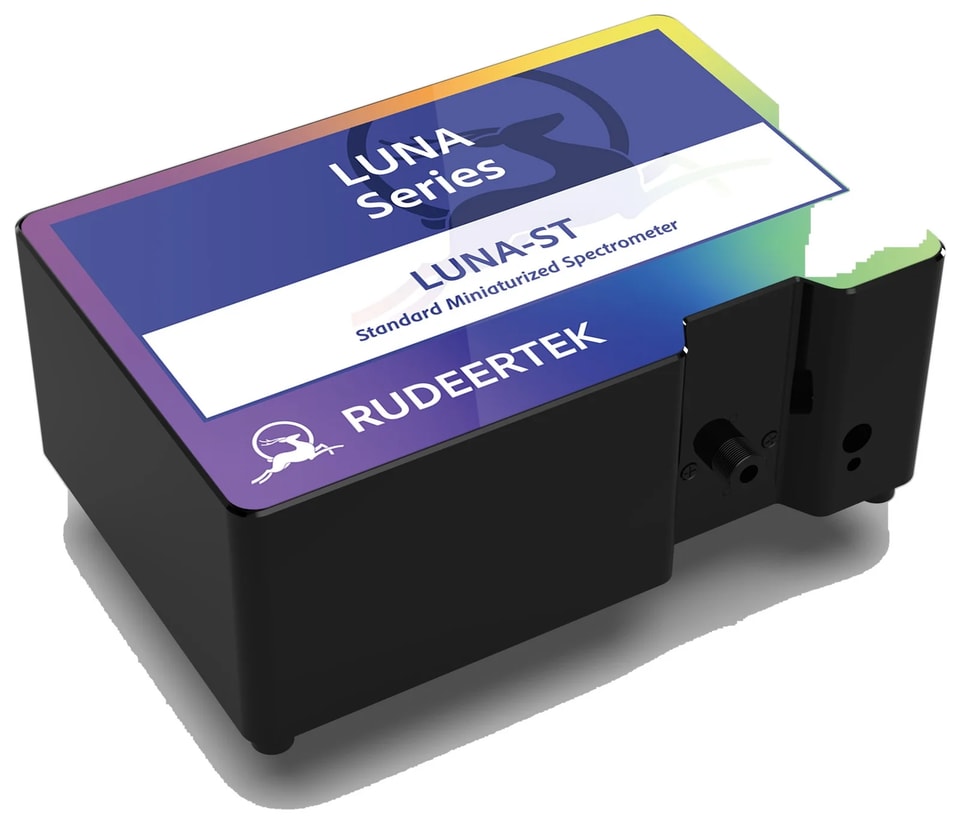
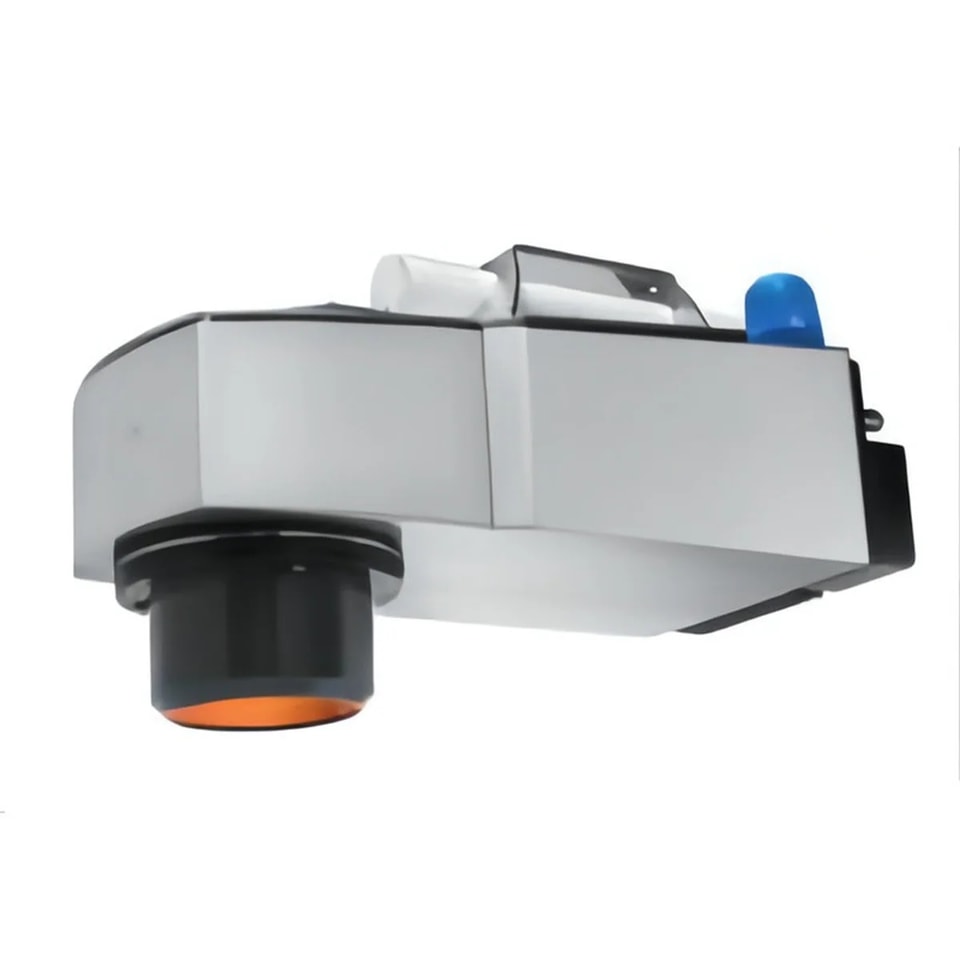
LUNA-ST High-Stability Miniature Fibre-Optic Spectrometer
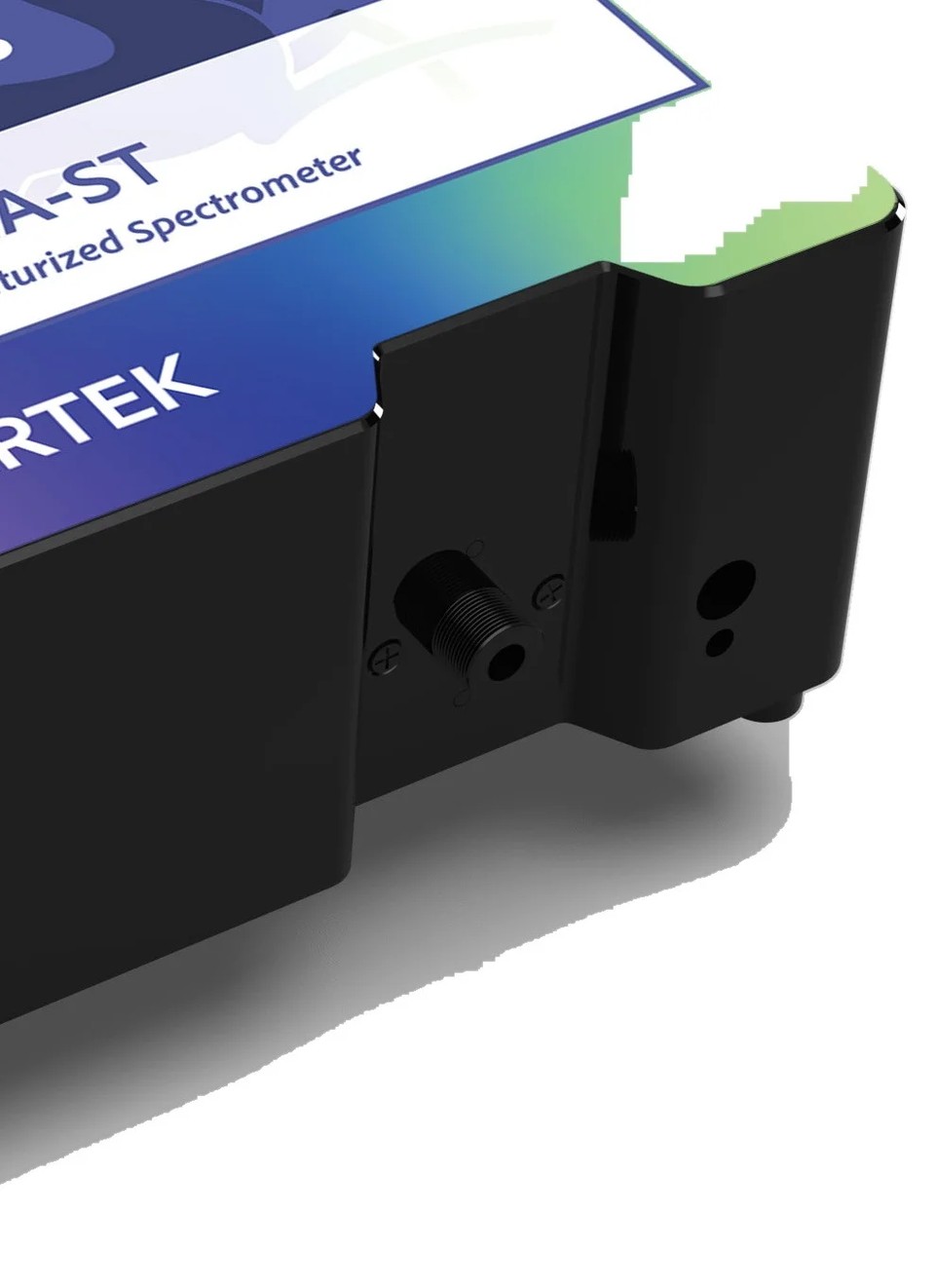
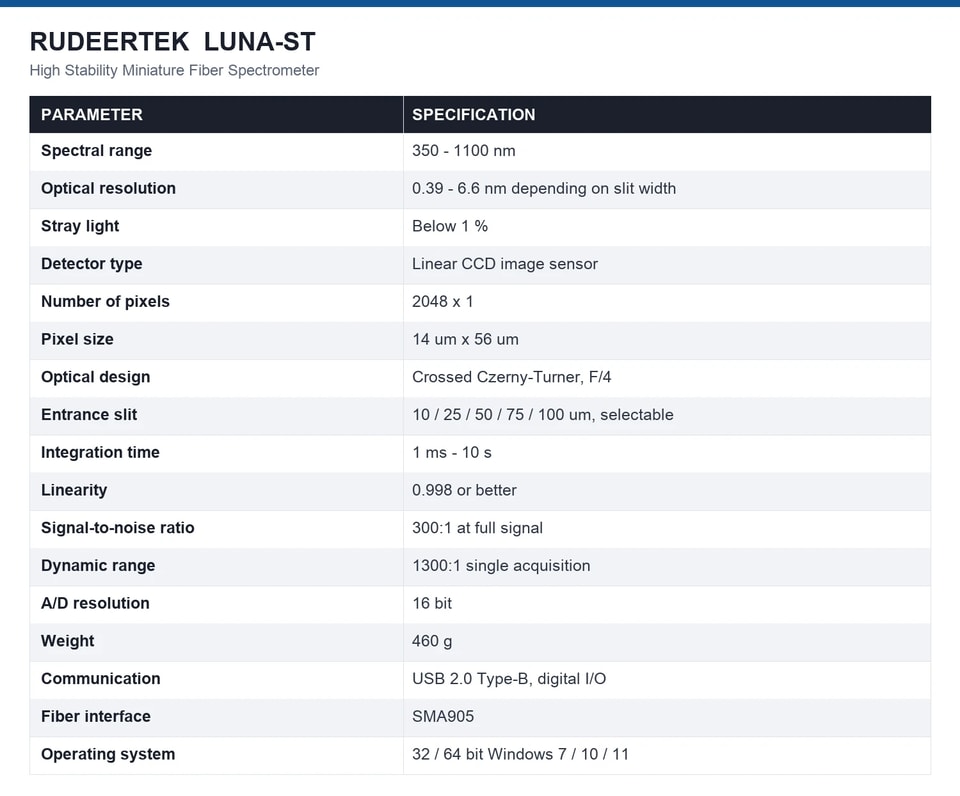
The LUNA-ST is a miniature fiber-optic spectrometer covering 350 to 1100 nm with a 2048-element linear CCD array and a crossed Czerny-Turner optical bench at F/4. The design is deliberately conventional where it matters: a fixed grating, a stabilised detector clock and a thermally stable bench, so the wavelength axis does not wander when the instrument warms up, which is what makes a compact spectrometer usable for quantitative work and not only for looking at a spectrum. Optical resolution runs from 0.39 to 6.6 nm depending on the entrance slit, chosen from 10, 25, 50, 75 or 100 um at order, and stray light stays below 1 %. Integration time from 1 ms to 10 s covers both a bright lamp and a dim fluorescence signal, the 16-bit A/D gives a 1300:1 dynamic range in a single acquisition, and the signal-to-noise ratio is 300:1 at full signal. The body weighs 460 g, takes an SMA905 fiber and connects over USB 2.0 Type-B with digital I/O, running on 32 or 64 bit Windows 7, 10 or 11.
· 2048-element linear CCD with a crossed Czerny-Turner bench at F/4, covering 350 to 1100 nm in one shot.
· Optical resolution from 0.39 to 6.6 nm set by the entrance slit, available in 10, 25, 50, 75 or 100 um.
· Stray light below 1 % and a 16-bit A/D with 1300:1 dynamic range in a single acquisition, so weak and strong lines coexist.
· Integration time from 1 ms to 10 s, which covers a bright halogen lamp and a dim fluorescence signal with one instrument.
· Signal-to-noise ratio of 300:1 at full signal with a thermally stable bench, so the baseline holds over a long run.
· 460 g body with SMA905 fiber input, USB 2.0 Type-B and digital I/O, running on Windows 7, 10 or 11.
The LUNA-ST is used for absorbance and transmission measurement in the visible band, colour and LED testing, water and environmental analysis with colorimetric reagents, food and beverage quality checks, thin-film and coating measurement, plasma and emission monitoring, and as the detector inside a larger analytical instrument. Its range also covers the fluorescence and Raman-shift region up to 1100 nm, so it is often the first spectrometer in a lab that is building an optical measurement method.
How do I choose the slit?
The slit sets the trade-off between resolution and light throughput. A 10 um slit gives the 0.39 nm end of the resolution range but passes little light, so it suits a strong source or a laser line. A 100 um slit gives more light and about 6.6 nm resolution, which is right for absorbance in a turbid sample. 25 um is the usual compromise.
Is it stable enough for quantitative analysis?
Yes, if the instrument is allowed to warm up and the integration time is fixed. The bench is thermally stable and the detector timing is fixed, so the baseline holds; for long runs, take a dark and a reference scan on the same schedule as your samples.
What fiber and accessories do I need?
An SMA905 patch cord, a light source matched to the band (halogen for the visible, deuterium-halogen for UV), and a cuvette holder or a reflectance probe. The spectrometer is the detector only; the optical path in front of it decides what you can measure.
Can it measure beyond the visible?
The CCD responds from 350 to 1100 nm, so it covers the near UV, the whole visible band and the first part of the near infrared. For moisture, protein or polymer bands beyond 1100 nm, the LINA series with an InGaAs array is the right instrument.
How is it connected and programmed?
USB 2.0 Type-B to a PC, with digital I/O for triggering, on 32 or 64 bit Windows 7, 10 or 11. Spectra are acquired through the supplied software or through the SDK, and the SMA905 input accepts any standard fiber.
Solutions & Support
We go the extra mile to thoroughly analyze each project and deliver tailored business solutions that meet your specific requirements.
Contact US
×