

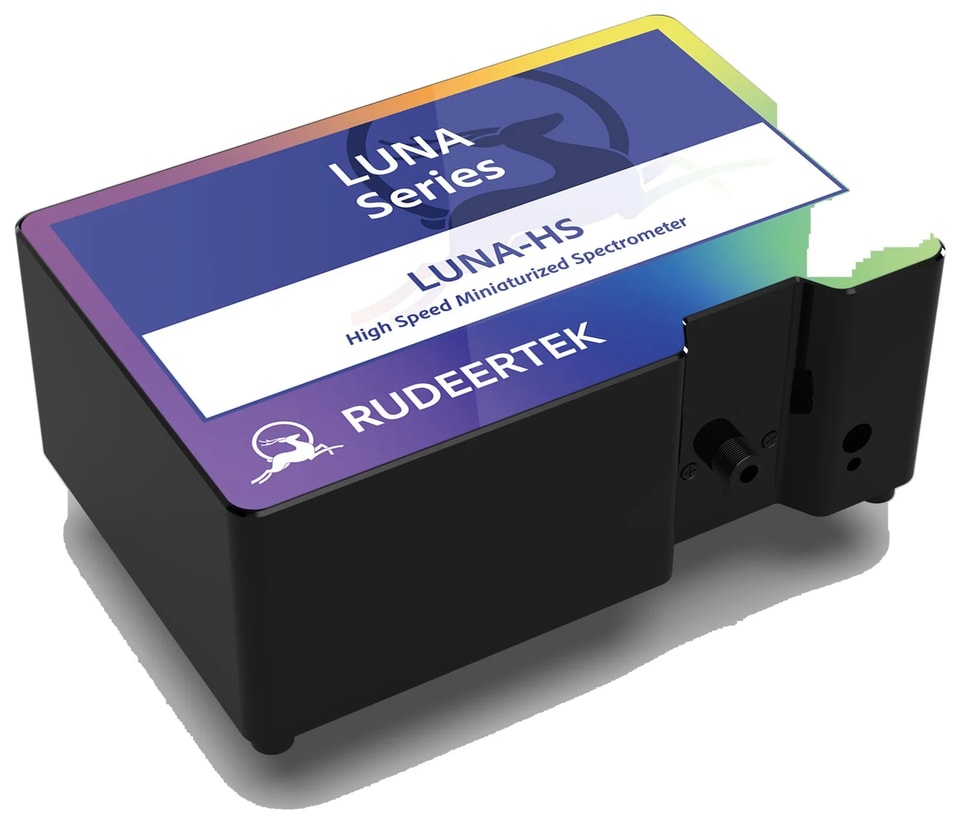
LUNA-HS High-Speed Miniature Spectrometer
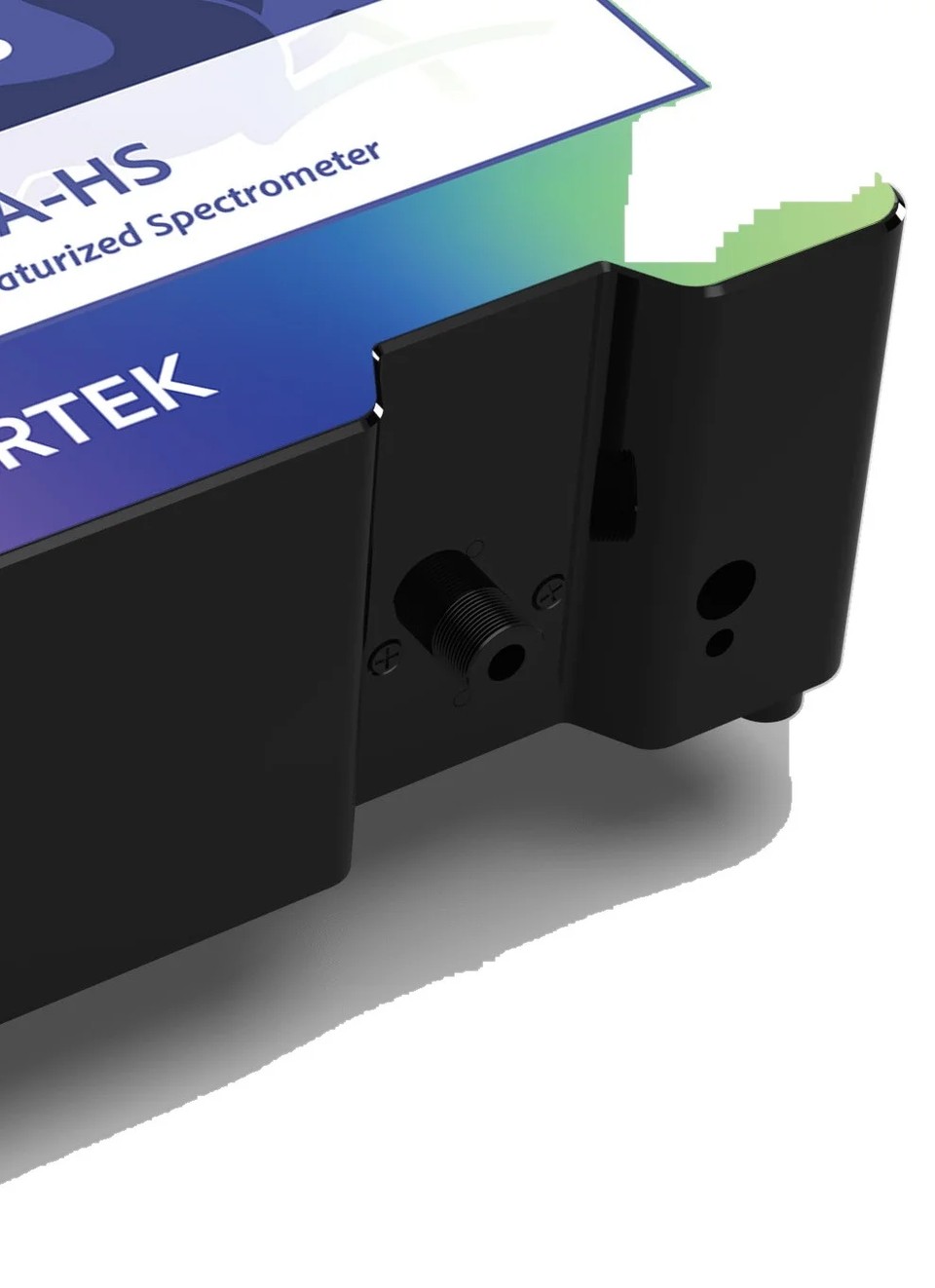
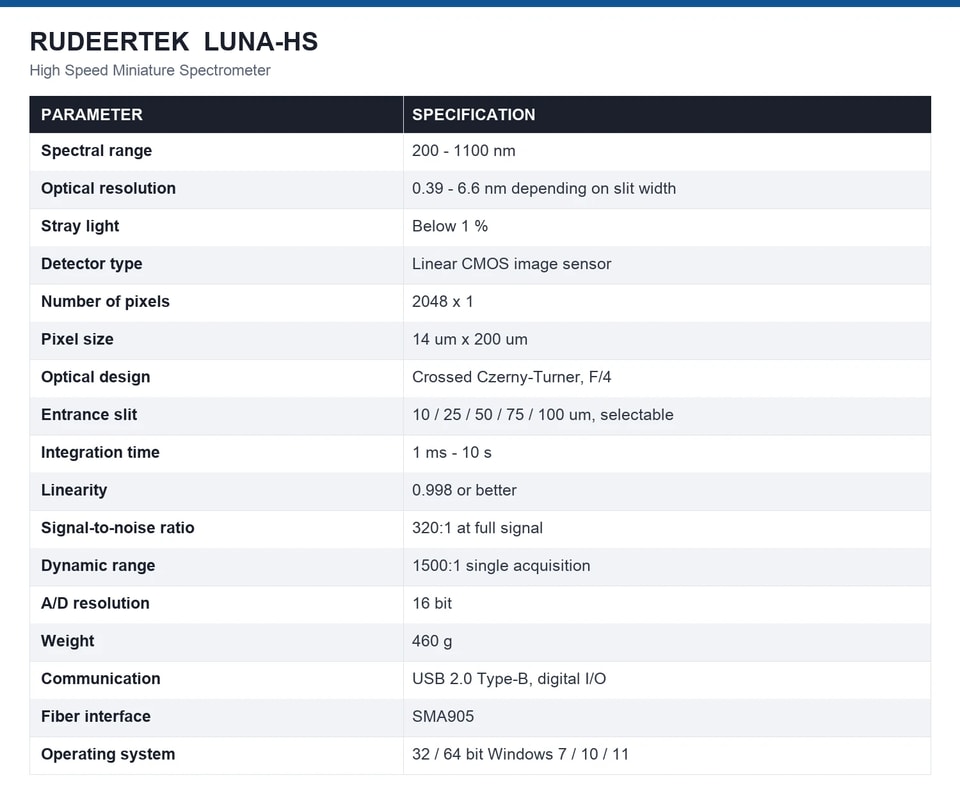
The LUNA-HS is the extended-range version of the LUNA miniature spectrometer: a linear CMOS array with 2048 pixels behind a crossed Czerny-Turner bench at F/4, covering 200 to 1100 nm, so the deep ultraviolet from a deuterium lamp and the whole visible band are captured in a single acquisition. Compared with a CCD of the same format, the CMOS array brings a higher dynamic range of 1500:1 in one shot and a signal-to-noise ratio of 320:1 at full signal, which matters when a strong emission line and a weak absorbance band have to be measured together. Optical resolution is 0.39 to 6.6 nm depending on the slit, chosen from 10 to 100 um, stray light stays below 1 %, and the integration time runs from 1 ms to 10 s. The housing is the same 460 g module as the rest of the LUNA series, with an SMA905 fiber input, USB 2.0 Type-B and digital I/O.
· Covers 200 to 1100 nm in one acquisition, so UV absorbance and visible colour are measured with the same instrument.
· 2048-pixel linear CMOS array gives 1500:1 dynamic range in a single shot, better than a CCD of the same format.
· Signal-to-noise ratio of 320:1 at full signal, with stray light below 1 % for reliable absorbance at high optical density.
· Optical resolution 0.39 to 6.6 nm, set by a 10, 25, 50, 75 or 100 um entrance slit chosen at order.
· Integration time 1 ms to 10 s covers a bright deuterium lamp and a weak fluorescence signal without changing hardware.
· 460 g module with SMA905 input, USB 2.0 Type-B and digital I/O, running on 32 or 64 bit Windows 7, 10 or 11.
The LUNA-HS is used where the measurement starts in the ultraviolet: water and wastewater analysis by colorimetric and UV absorbance methods, HPLC and capillary electrophoresis detectors, protein and nucleic acid quantification at 260 and 280 nm, ozone and SO2 monitoring, UV curing lamp inspection, and emission monitoring where a strong line and a weak band occur in the same spectrum. It is also used as an OEM detector inside analytical instruments that need the UV end of the spectrum without a second spectrometer.
Why choose this over the LUNA-ST?
The LUNA-ST starts at 350 nm and uses a CCD; the LUNA-HS starts at 200 nm and uses a CMOS array with a higher dynamic range. If your method needs UV absorbance below 350 nm, or if a strong line and a weak band share one spectrum, the HS is the better fit.
Does it need a special fiber for UV?
Yes. Standard silica fiber absorbs strongly below about 250 nm, so a UV-grade fiber is needed to use the 200 to 250 nm region. Above 300 nm an ordinary patch cord is fine.
How much light do I need for the UV end?
A deuterium or deuterium-halogen source, because a tungsten halogen lamp has almost no output below 350 nm. The 200 um pixel height gives a good signal from a fiber-coupled deuterium lamp with a 25 or 50 um slit.
What about stray light at high absorbance?
Stray light is below 1 %, which limits useful absorbance to about 2 AU. For higher optical density, dilute the sample or use a shorter path length rather than pushing the integration time.
How is it integrated into an instrument?
Through the SMA905 input and the USB 2.0 Type-B link, with digital I/O for triggering. The module is 460 g and can be mounted inside an OEM enclosure; the SDK gives access to raw spectra and to the timing controls.
Solutions & Support
We go the extra mile to thoroughly analyze each project and deliver tailored business solutions that meet your specific requirements.
Contact US
×