

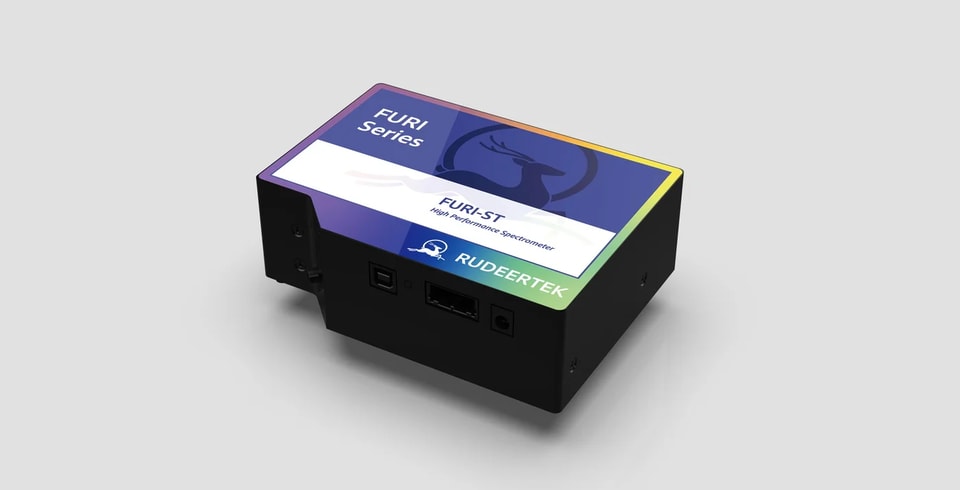
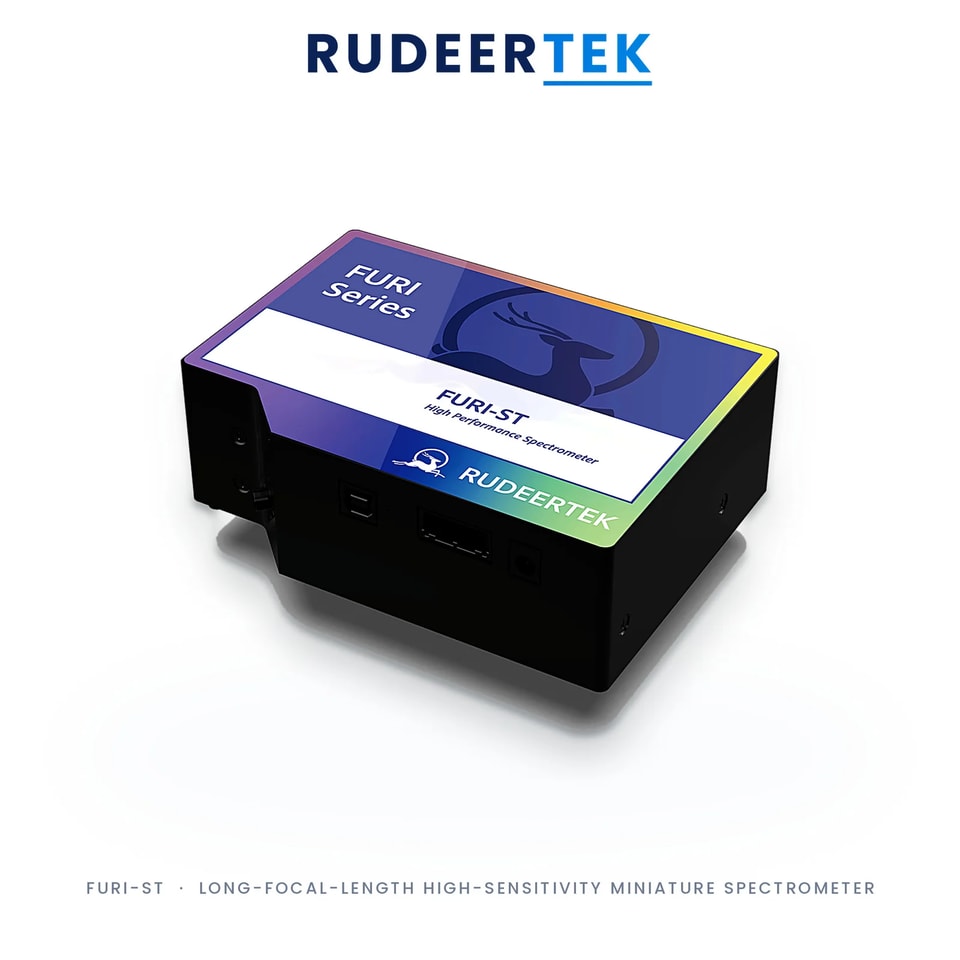
FURI-ST Long-Focal-Length High-Sensitivity Miniature Spectrometer
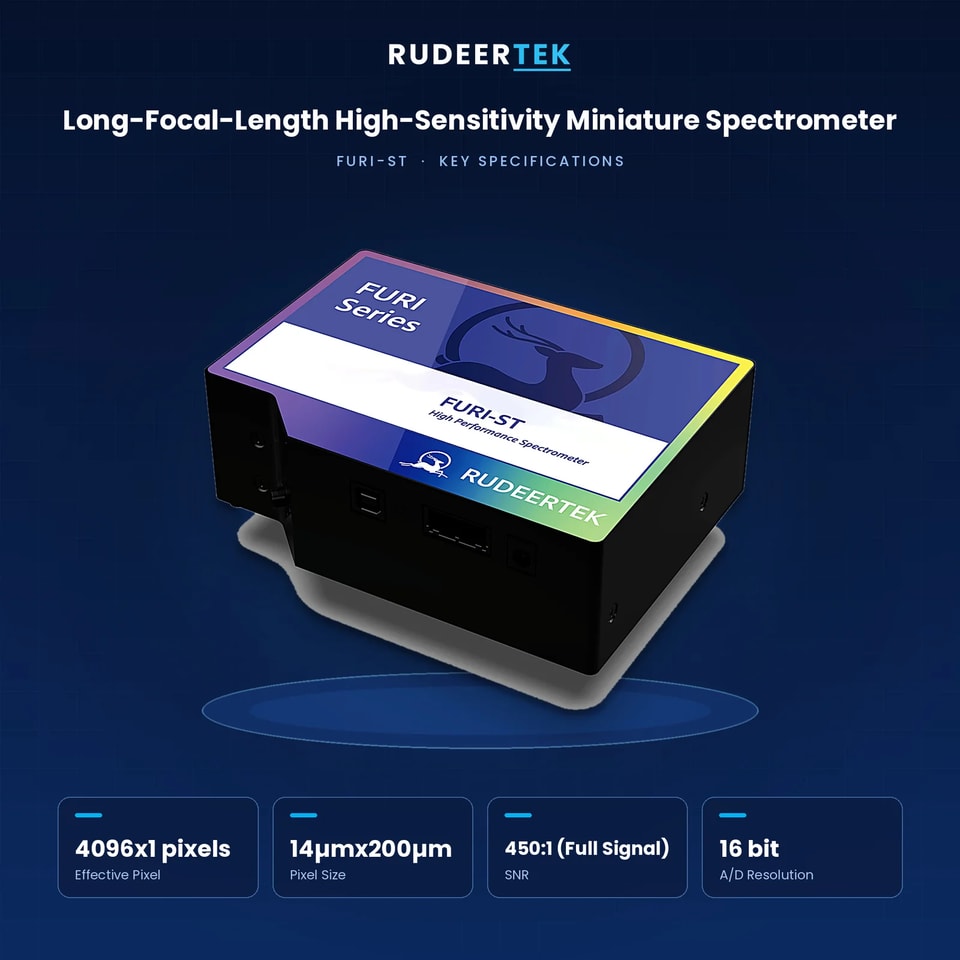
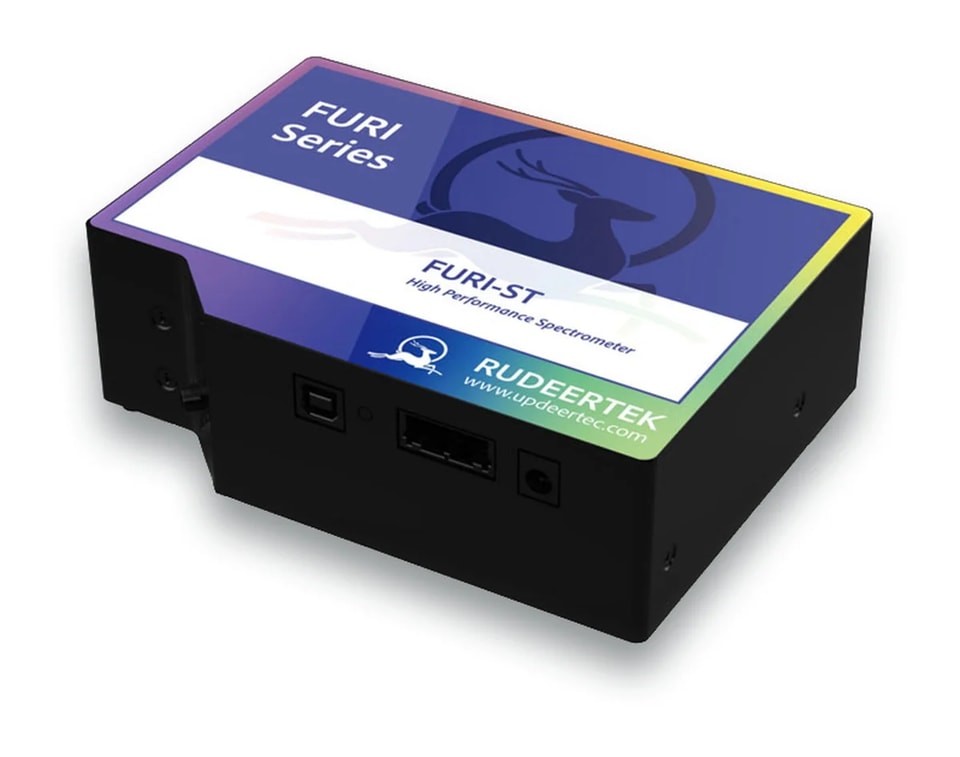
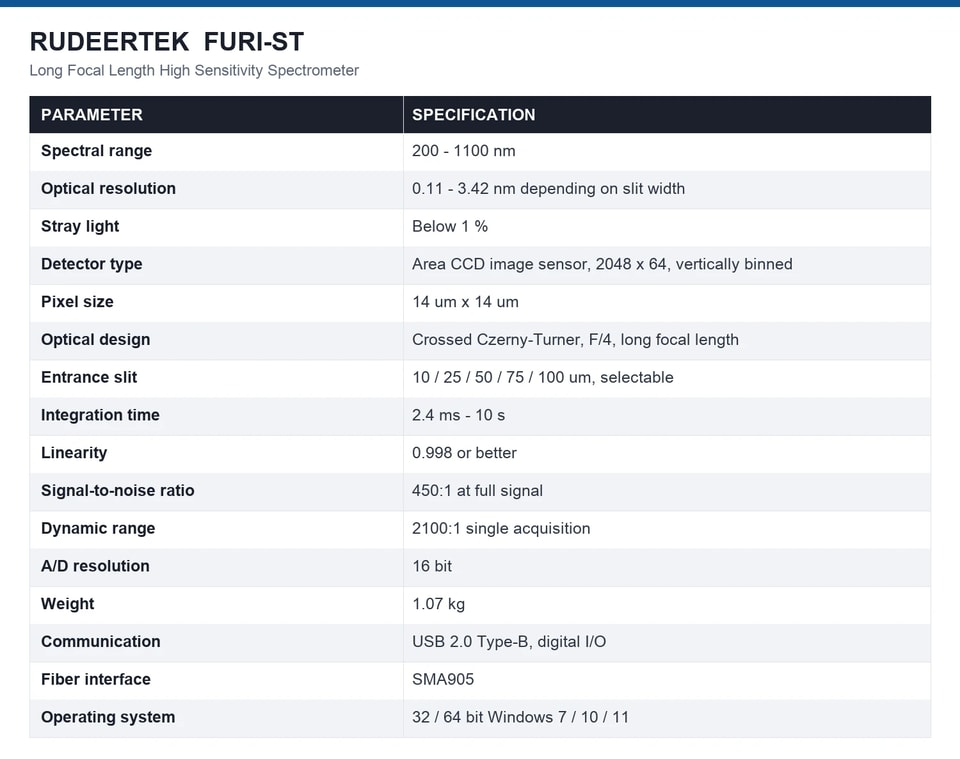
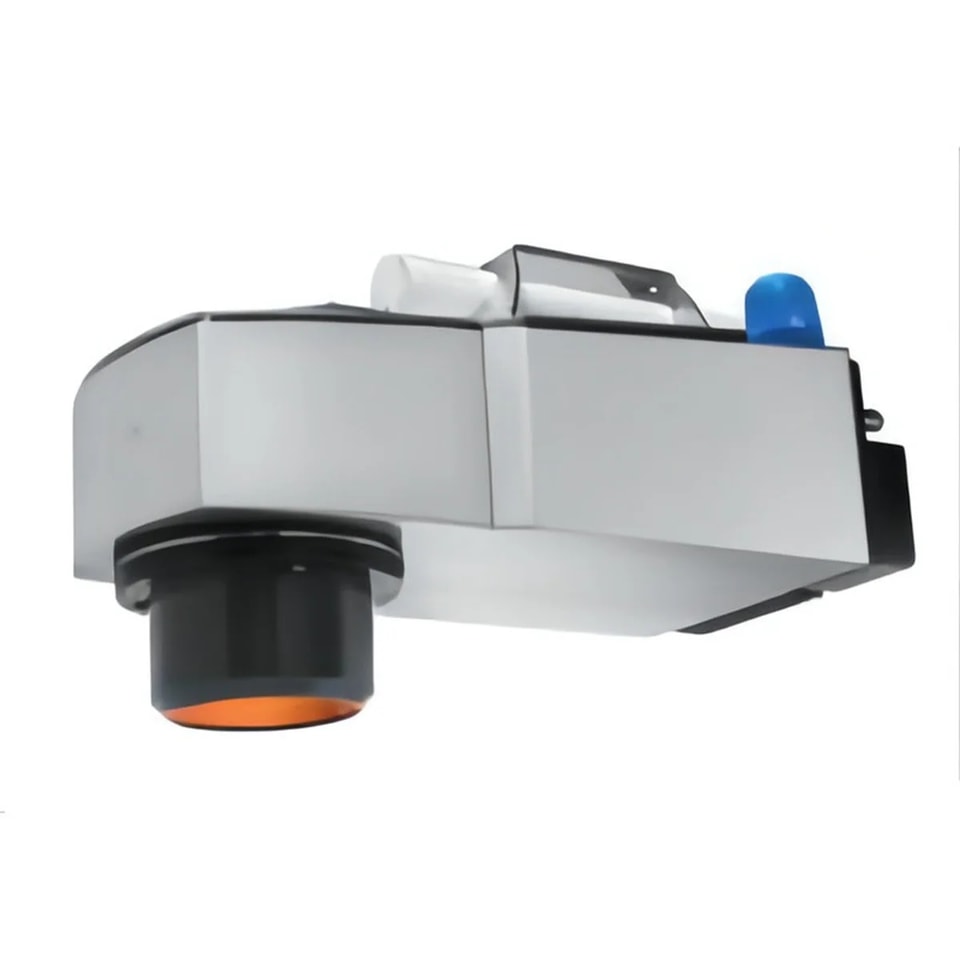
The FURI-ST is a long-focal-length spectrometer built for resolution and sensitivity rather than for size. A 2048 x 64 pixel area CCD sits behind a crossed Czerny-Turner bench at F/4, and the 64 rows are binned vertically, which raises the signal without widening the entrance slit; the result is optical resolution down to 0.11 nm with a signal-to-noise ratio of 450:1 at full signal, against 300:1 for a single-row miniature bench. The range is 200 to 1100 nm, stray light stays below 1 %, the dynamic range is 2100:1 in one acquisition and the A/D is 16 bit. The integration time starts at 2.4 ms rather than 1 ms because of the larger detector, and the body weighs 1.07 kg, which is still portable but no longer pocket-sized. An SMA905 fiber input, USB 2.0 Type-B and digital I/O are standard.
· Long focal length and 0.11 nm resolution at the narrow-slit end, four times finer than a standard miniature bench.
· 2048 x 64 pixel area CCD binned vertically, so sensitivity rises without opening the slit and losing resolution.
· 450:1 signal-to-noise ratio at full signal, against 300:1 for a single-row detector of the same size.
· 2100:1 dynamic range in a single acquisition and a 16-bit A/D, so weak bands survive next to strong lines.
· Covers 200 to 1100 nm with stray light below 1 %, for UV absorbance and visible emission in one scan.
· 1.07 kg housing with SMA905 input, USB 2.0 Type-B and digital I/O, and a 2.4 ms minimum integration time.
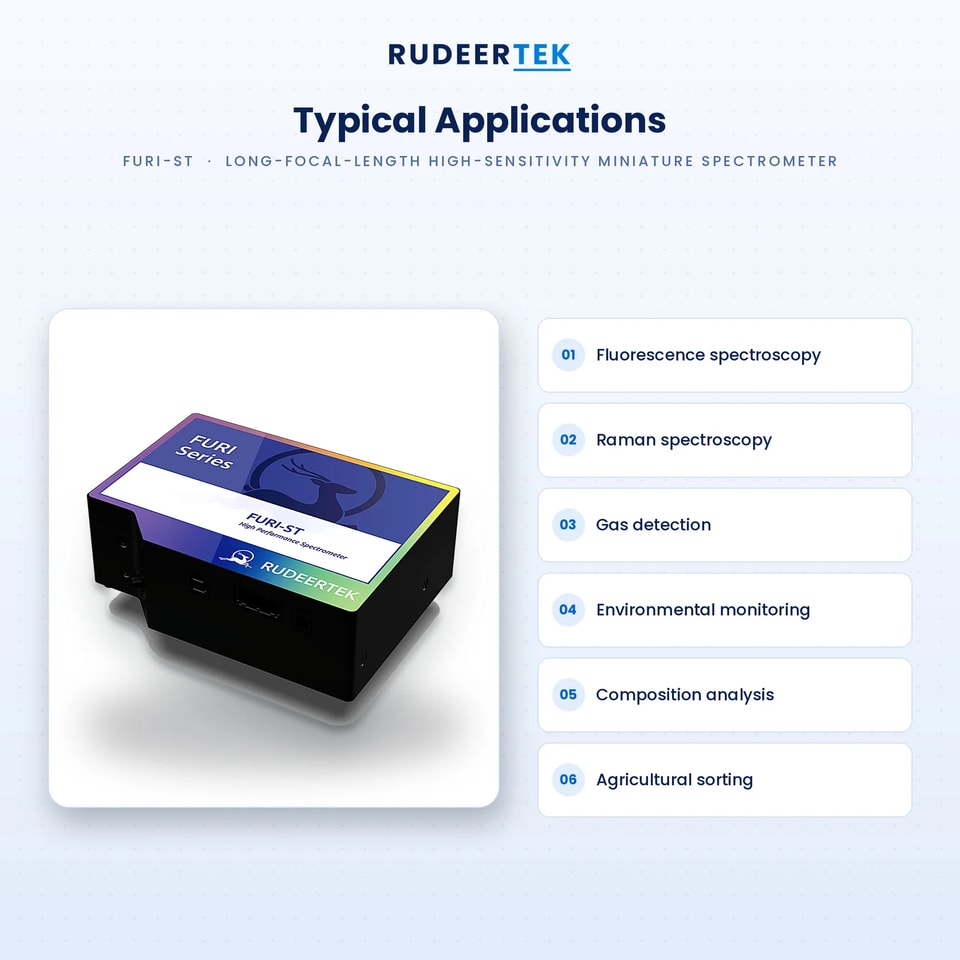
The FURI-ST is used for Raman and fluorescence spectroscopy in the visible, plasma and emission line identification, laser characterisation, colour and spectral power distribution measurement, and any laboratory method where a 0.11 nm bandpass matters. It is also the detector of choice for OEM instruments built around a fiber probe where a miniature bench cannot resolve the feature of interest, and for teaching and research benches that need a stable, calibrated wavelength axis.
What does the 64-row detector actually do?
The 64 rows are summed on chip. A signal that falls across the slit height is collected from all 64 rows instead of one, so the signal grows by roughly a factor of 64 while the read noise grows only with the square root of that, and the slit stays narrow enough to keep 0.11 nm resolution.
Why is the minimum integration time 2.4 ms?
Because the area detector has more pixels to shift out than a single-row array. That is still fast enough for most laboratory work; only a pulsed or transient measurement below 2 ms would need a different platform.
Do I need a longer focal length or just a narrower slit?
Both improve resolution but in different ways. Narrowing the slit always costs light; a longer focal length improves the dispersion itself. The FURI-ST gives 0.11 nm at the narrow end while keeping a 450:1 signal-to-noise ratio, which a miniature bench cannot do at that resolution.
Is 1.07 kg still practical for a portable instrument?
For a benchtop or an instrument enclosure, yes. It is not a handheld module; if size and weight dominate, the LUNA series at 460 g is the alternative, at the cost of resolution.
What software and interface does it use?
USB 2.0 Type-B with digital I/O, running on 32 or 64 bit Windows 7, 10 or 11, with an SMA905 fiber input. Acquisition and processing go through the supplied software or the SDK.
Solutions & Support
We go the extra mile to thoroughly analyze each project and deliver tailored business solutions that meet your specific requirements.
Contact US
×